
Suno's Training Data Just Leaked. What Producers Should Know.
Short answer: A July 2026 breach reportedly exposed Suno source code with comments referencing Genius, YouTube Music, Deezer, Freesound, and Jamendo as training sources, according to a 404 Media investigation. Suno says it trains on publicly available music files. For producers, the question is provenance: whose DNA is in your release?
What the report says
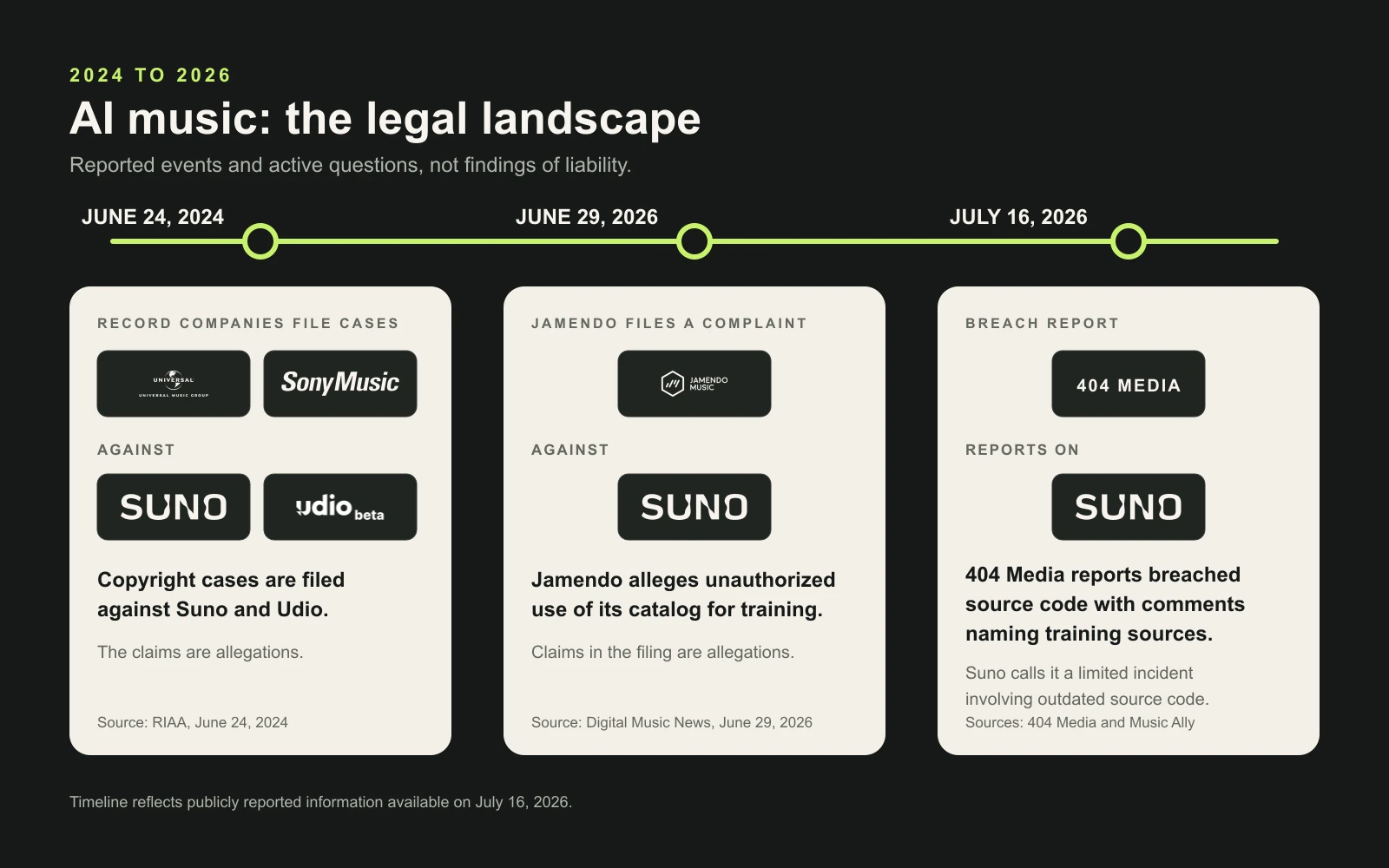
404 Media reports that a hacker breached Suno and shared data about its training libraries. According to that report, source code appearing to date from 2023 and 2024 contained comments referencing Genius, YouTube Music, Deezer, Freesound, and Jamendo. Those are allegations reported from breached material, not findings by a court.
In a response published by Music Ally, a Suno spokesperson said its models were trained on “publicly available music files and related metadata accessible on third-party websites on the open Internet.” Suno called the breach “a limited security incident that was quickly contained” and said the material involved old source code that is no longer used.
Music Ally also reports that Jamendo is suing Suno, alleging unauthorized training on its catalog. Music Business Worldwide reports that Universal Music Group and Sony Music remain in active litigation with Suno. The claims in these cases remain allegations unless and until a court decides otherwise.
Why producers should care
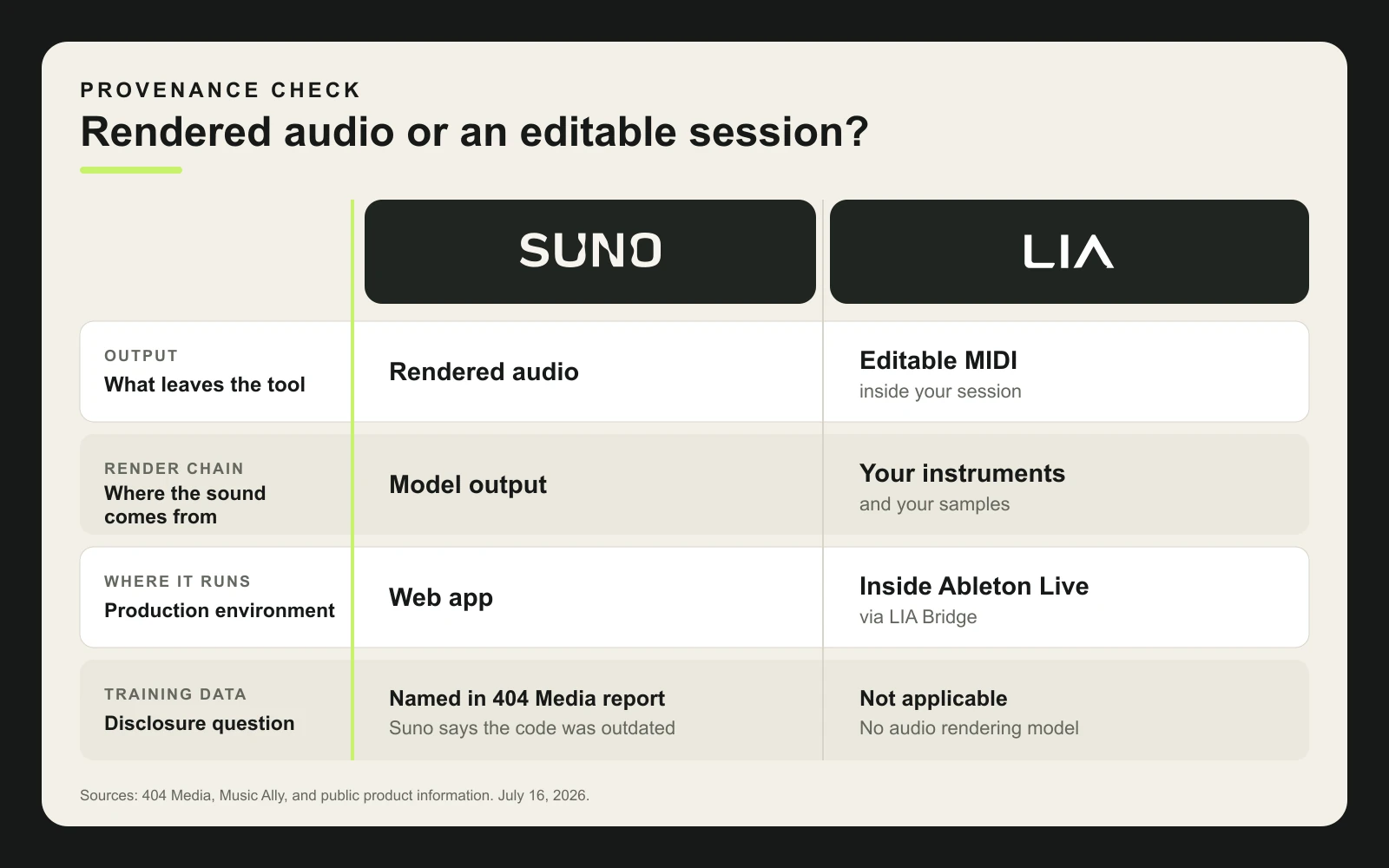
This is not an abstract argument about whether a tool is good or bad. It is a practical question about the provenance of a master. If a track arrives as rendered audio from a generator, you cannot inspect the model's training corpus from the audio file. That does not prove the track infringes anyone's rights, but it limits what you can independently verify about the render chain.
That matters when a label, sync partner, or distributor asks how a recording was made. In July 2026, a coalition of music organizations proposed voluntary labels distinguishing AI-generated recordings from AI-assisted recordings, according to Music Business Worldwide. The proposal is not law, but it shows where industry expectations are moving: toward clearer disclosure.
The useful question is not simply whether AI touched the process. Ask whether you can explain where the sounds came from, what remains editable, and who controls the final render.
Assistant vs generator: the provenance difference
A generator returns audio rendered by its model. A copilot such as LIA works differently. LIA writes editable MIDI and session actions inside Ableton Live. Your instruments produce the sound, your samples stay in the chain, and the final render comes from your own session.
That distinction does not make every copyright question disappear. It gives the producer a render chain they can inspect and control. You can see the MIDI, replace an instrument, remove a sample, change a note, and render again from the project you own.
For a broader workflow breakdown, read AI music assistant vs AI music generator. For a direct product comparison, see LIA vs Suno.
Questions to ask any AI music tool
Does it output rendered audio or editable material?
Rendered audio is fast to audition but difficult to inspect note by note. Editable MIDI and session actions leave the production decisions open. LIA outputs the second kind inside Ableton Live.
Whose sounds are in the render chain?
Ask whether the audio comes from a model, from your licensed instruments and samples, or from a combination of both. If the tool cannot answer clearly, treat that as a due diligence gap.
Can you verify what the model was trained on?
Look for a direct disclosure from the provider, then compare it with independent reporting and court filings. A confident marketing answer is not the same as a documented source list.
Who owns the output?
Provider terms differ, and commercial use rights are not the same as copyright protection. Read the current terms for the plan you used and get legal advice when a release carries meaningful commercial risk.
Frequently asked questions
What was Suno trained on?
Suno says its AI models were trained on publicly available music files and related metadata accessible on third-party websites on the open Internet. A July 2026 404 Media report says breached source code included comments naming Genius, YouTube Music, Deezer, Freesound, and Jamendo. Suno said the code was outdated and described the incident as limited.
Is AI-generated music copyrightable?
It depends on the jurisdiction and the amount of human authorship. The legal landscape around AI-generated music is still evolving, so producers should check current rules and get legal advice before relying on a generated track for a commercial release.
What is the difference between an AI assistant and an AI generator?
An AI generator returns audio rendered by a model. An AI assistant works in the producer's own session and returns editable material or performs session actions. LIA follows the assistant model: it writes editable MIDI and session actions inside Ableton Live rather than returning a finished audio render.
Does LIA generate audio?
No. LIA creates editable MIDI and session actions inside Ableton Live. Your instruments, samples, and session render the audio.
Sources
- 404 Media: Hack Reveals Suno AI Music Generator Scraped YouTube, Deezer, and Genius
- Music Ally: Suno adds iMessage, but a hack may have revealed its training data
- Music Business Worldwide: Suno and the proposed AI labeling system
- Digital Music News: Jamendo Music files suit against Suno
- RIAA: 2024 cases involving Suno and Udio
The useful dividing line is not AI versus no AI. It is whether a tool hands you a finished render or keeps the work editable in your session. Compare LIA and Suno, then join the LIA waitlist if producer-controlled output is the workflow you want.