
Compare
LIA vs Suno
The short answer: Suno generates finished songs as audio from a text prompt, in your browser or its app. LIA works inside Ableton Live, producing editable MIDI and session actions you control. If you want a complete track to download, pick Suno. If you are a producer who wants the result to stay editable in your DAW, pick LIA.
Both show up when people search for AI music tools, so they get compared, but they answer different questions. This page sets them side by side on the four things that decide it: where each one runs, what it outputs, how editable the result is inside a DAW, and who it fits. Suno details below reflect its public pages as of July 2026.
Side by side
| LIA | Suno | |
|---|---|---|
| Where it runs | Inside Ableton Live, through the LIA Bridge, driven from your browser on desktop or phone | In your browser and in the Suno mobile app |
| Output type | Editable MIDI plus track and session actions inside your Ableton project | A finished song as an audio file |
| Editability in a DAW | Full: every note, chord, and pattern lands in your session and stays editable with your own instruments | You receive a rendered track rather than a session you build note by note |
| Who it is for | Producers who work in Ableton Live and want to move faster without giving up control | Anyone who wants a complete track quickly, including people with no music experience |
Suno facts verified against suno.com as of July 2026. Rows that could not be verified are left out on purpose.
July 2026: the training data question
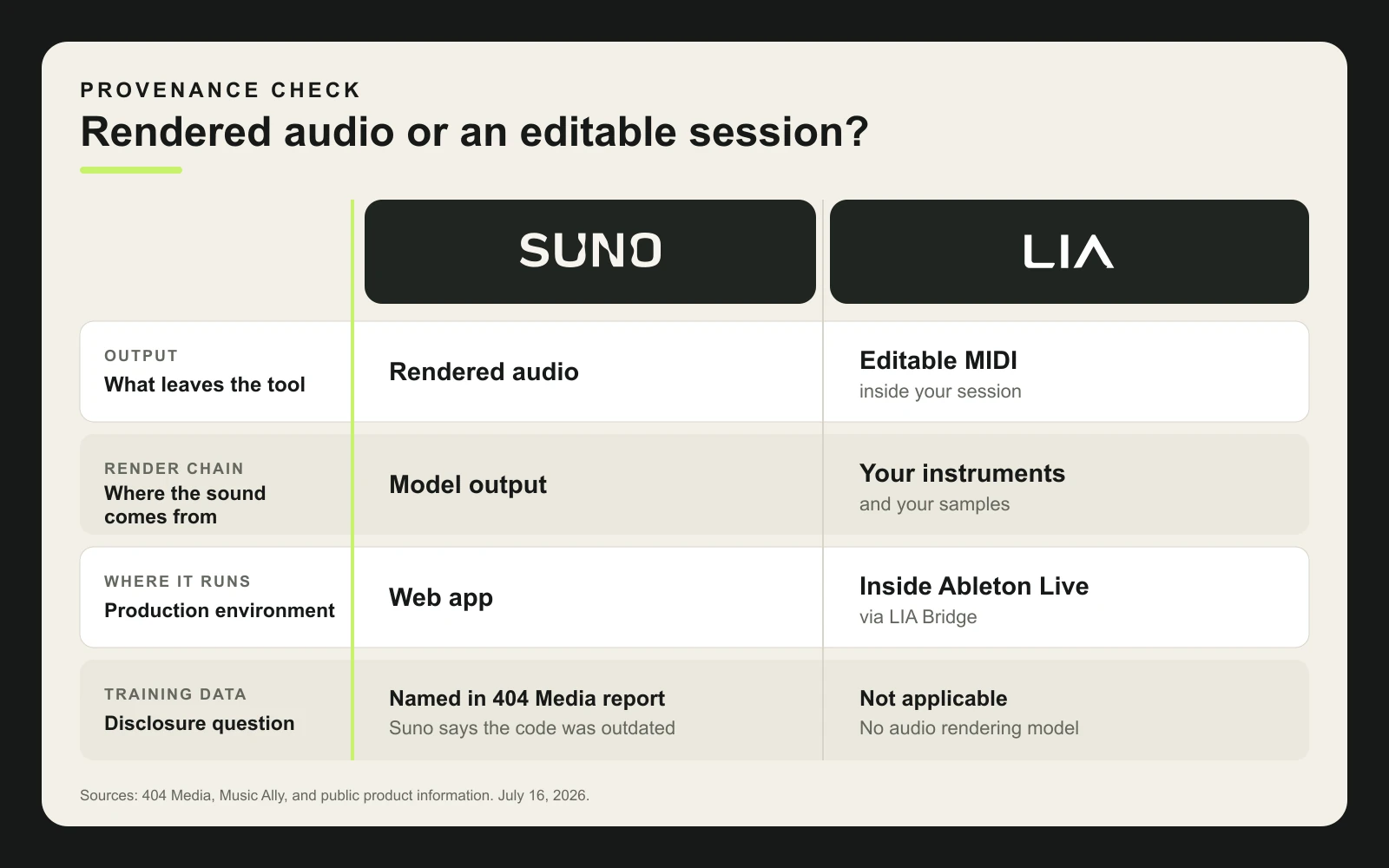
404 Media reported that breached Suno source code appearing to date from 2023 and 2024 included comments referencing Genius, YouTube Music, Deezer, Freesound, and Jamendo as training sources. Music Ally reported that Suno described the breach as limited, said the code was outdated, and reiterated that its models were trained on publicly available music files and related metadata on third-party websites.
The report does not establish that a particular Suno output infringes anyone's rights. It does sharpen the practical question for producers: can you inspect and explain the render chain behind a release? Read the full, sourced breakdown in Suno's training data leak: what producers should know.
Pick a side
-
Choose Suno if
- You want a finished song you can download and use right away.
- You do not work in a DAW and do not want to open one.
- You need background tracks, quick reference ideas, or a mood board more than an editable session.
- Typing a description and getting a complete result is exactly the workflow you want.
-
Choose LIA if
- You produce in Ableton Live and want the output to land in your session.
- You need every note, chord, bassline, and drum pattern to stay editable.
- You want to use your own instruments, presets, and sound libraries.
- You want to move faster inside your DAW without handing off creative control.
The honest version
This is not about which tool is better. Suno removes the need for a DAW; LIA makes the DAW faster. A finished-audio generator and an in-DAW assistant are not really competitors, and plenty of producers use one for early ideas and the other to actually build the track. Pick by the output you need at the end: a rendered song, or an editable Ableton session.
FAQ
Frequently asked questions
Is there a Suno alternative that keeps MIDI editable?
Yes. LIA is a Suno alternative built for producers who need editable output. Instead of returning a finished audio file, LIA works inside Ableton Live and writes editable MIDI: notes, chords, basslines, and drum patterns you can change, plus track and session actions you direct.
What is the difference between LIA and Suno?
Suno turns a text prompt into a finished song as audio, in your browser or its mobile app. LIA runs inside Ableton Live through the LIA Bridge, the small helper app that connects LIA to Ableton Live, and produces editable MIDI and session actions rather than a rendered track.
Can I use LIA and Suno together?
You can. Some producers sketch an idea in a finished-audio generator, then rebuild and finish the track in Ableton Live with LIA handling editable MIDI and session work. They solve different parts of the process, so they can sit side by side.
Does LIA generate finished songs like Suno?
No. LIA does not hand you a finished, rendered song. It helps you build the track yourself inside Ableton Live, keeping every note and production choice editable. If you want a complete audio file without opening a DAW, Suno is the better fit.