
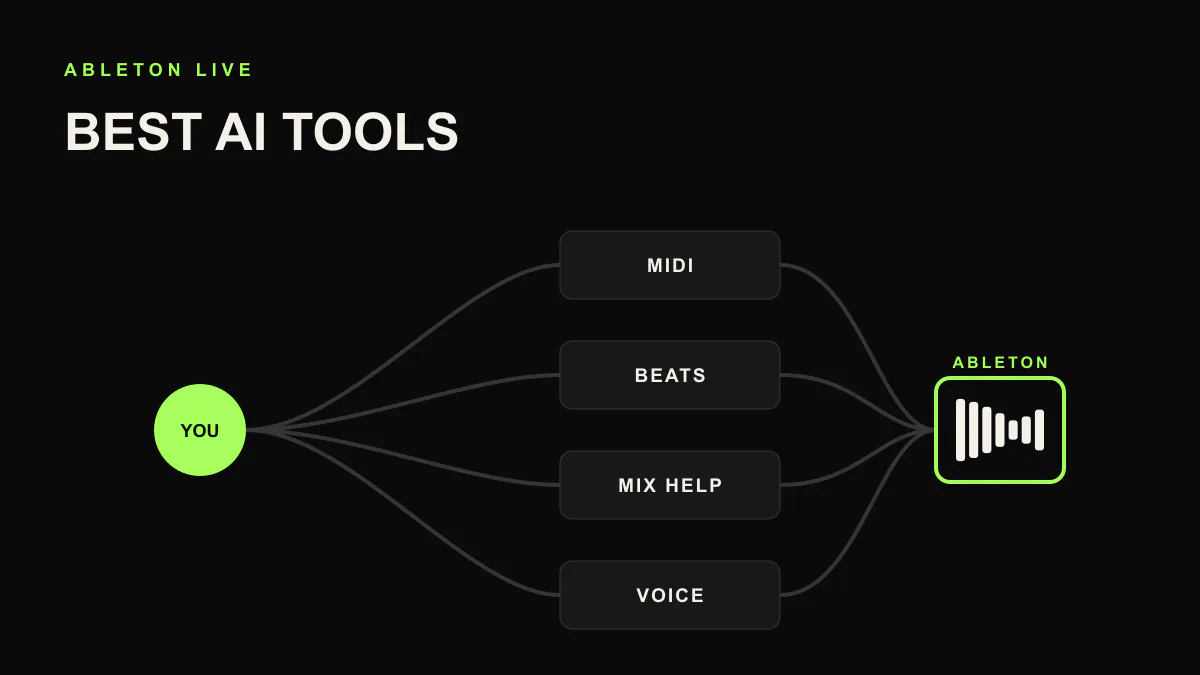
Best In-DAW AI Assistants for Ableton Live 2026
Short answer: For producing inside Ableton Live in 2026, LIA is the top pick: it controls your session through LIA Bridge, the small helper app that connects LIA to Ableton Live, and writes editable MIDI you own. AbletonGPT (now Yuma) and Jamu drive Ableton by chat, MIDI Agent generates MIDI as a plugin, and Magenta Studio is the free open-source baseline.
Search “best AI tools for Ableton” and Google answers with an AI Overview before you scroll. It lists Anthropic’s Claude Connector, Melosurf, Magenta Studio, iZotope and a few others. The list is mostly correct, except for what it omits.
Google’s AI Overview cannot tell you which of these tools live inside a running Ableton session and which are cloud generators that hand you a finished WAV. It cannot tell you that the assistants and the generators answer different questions, and that mixing them in the same comparison creates real confusion at the moment of purchase.
This guide fills that gap. We tested 6 AI tools for Ableton Live in May 2026 split into two camps: AI assistants that write MIDI inside your session, and AI generators that render audio in the cloud. Below is what works, what doesn’t, and why the difference matters.
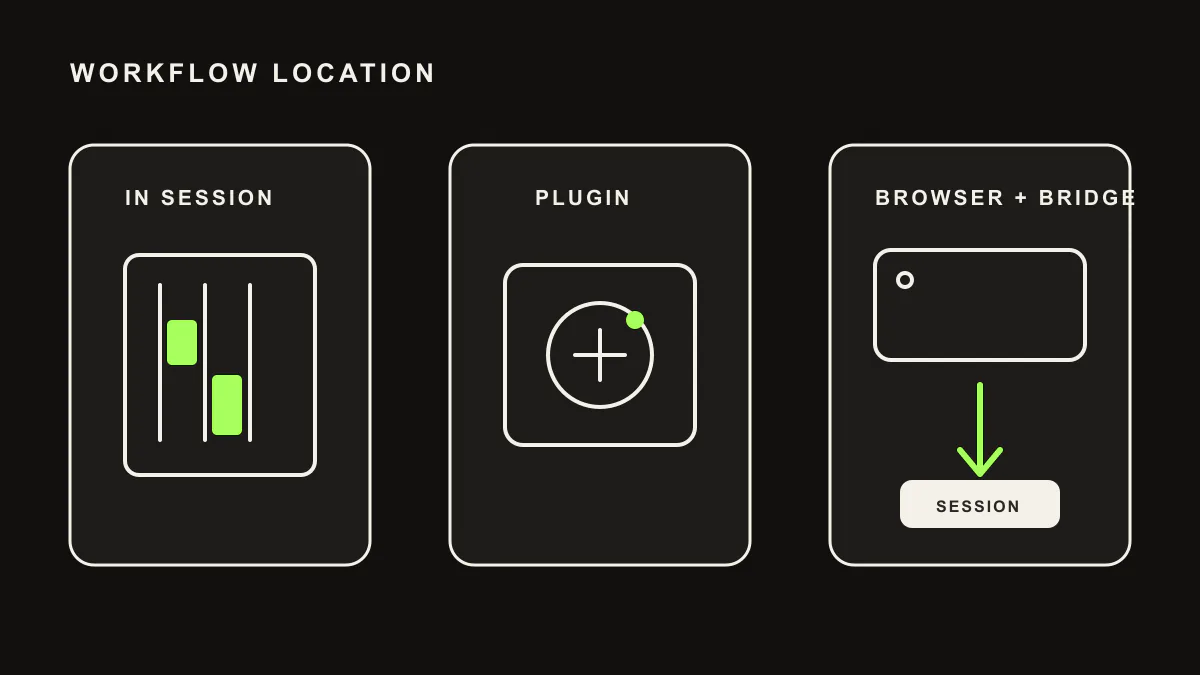
The 5 Best In-DAW AI Assistants for Ableton Live 2026 at a Glance
These five tools all run with Ableton Live rather than handing back a finished audio file. The table below compares how each connects, what it outputs, how you steer it, and where pricing starts (facts as of mid 2026; check each vendor for current terms).
| Tool | Works inside Ableton | Output type | Control style | Price entry point |
|---|---|---|---|---|
| LIA | Yes, via LIA Bridge (macOS, Windows) | Editable MIDI, in-session | Chat, plus voice (push-to-talk from Starter up, Realtime Talk Mode planned for launch from Studio up) | Free tier (10 trial productions), then Starter €24.99/mo |
| AbletonGPT (now Yuma) | Yes, native macOS and Windows app (as of June 2026) | MIDI in Ableton, plus drag-into-any-DAW export | Chat plus voice dictation, English only (as of June 2026) | Beta one-time $39, no free tier (as of June 2026) |
| Jamu | Yes, Ableton-only (MCP) | Editable MIDI, in-session | Chat | Free Demo tier, then $9/mo |
| MIDI Agent | Yes, loads as a VST plugin | Editable MIDI from a text prompt | Text prompt in the plugin | $49 one-time (regularly $99); no free trial |
| Magenta Studio | Yes, as a Max for Live device | Editable MIDI, in-session | Parameter controls (Continue, Drumify, Interpolate, Groove) | Free, open source |
The rest of this guide explains the split behind the table: assistants that write MIDI inside your session versus generators that render audio in the cloud. For head-to-head breakdowns see the comparison hub.
The Two Types of AI Tools for Music Production
Every AI tool for Ableton falls into one of two categories. They differ in where they run, what they output, and how much control you retain over the result.
1. AI Assistants
An AI assistant connects to your running Ableton Live session through a local bridge. You describe what you want in natural language. “add a 4-bar drum pattern at 128 BPM” or “dynamic movement idea the bass to the kick”, and the assistant executes the action directly inside your project.
The key distinction: an assistant does not generate audio. It creates MIDI clips, loads instruments, adjusts mixer settings, applies effects, and organizes your session. Every element it produces is fully editable inside Ableton. You keep complete control over individual tracks, notes, and parameters.
Because the assistant operates inside your session, it works with whatever plugins and instruments you already own. It does not replace your sound library. It uses it.
2. AI Generators
Generators take a text prompt and return a finished audio file, typically a stereo MP3 or WAV. You describe a vibe and the service renders a complete track in the cloud.
The output sounds polished, but it arrives as a flat audio file. You cannot isolate the kick from the hi-hat, change one chord, or adjust the mix. If you want to edit anything, you have to start over with a new prompt. The generated audio also carries licensing considerations that vary by provider and can affect distribution to streaming platforms.
Generators are useful for quick demos, reference tracks, or content that does not need to be deconstructed. They are not designed for production workflows where you need stem-level control.
Categories at a Glance: Assistant vs Generator
| Capability | AI Assistant | AI Generator |
|---|---|---|
| Works inside Ableton | Yes | No |
| Creates MIDI you can edit | Yes | No |
| Uses your plugins & instruments | Yes | No |
| Handles mixing & effects | Yes | No |
| Output ownership | 100% yours | Varies |
| Streaming-safe | Yes | Check license |
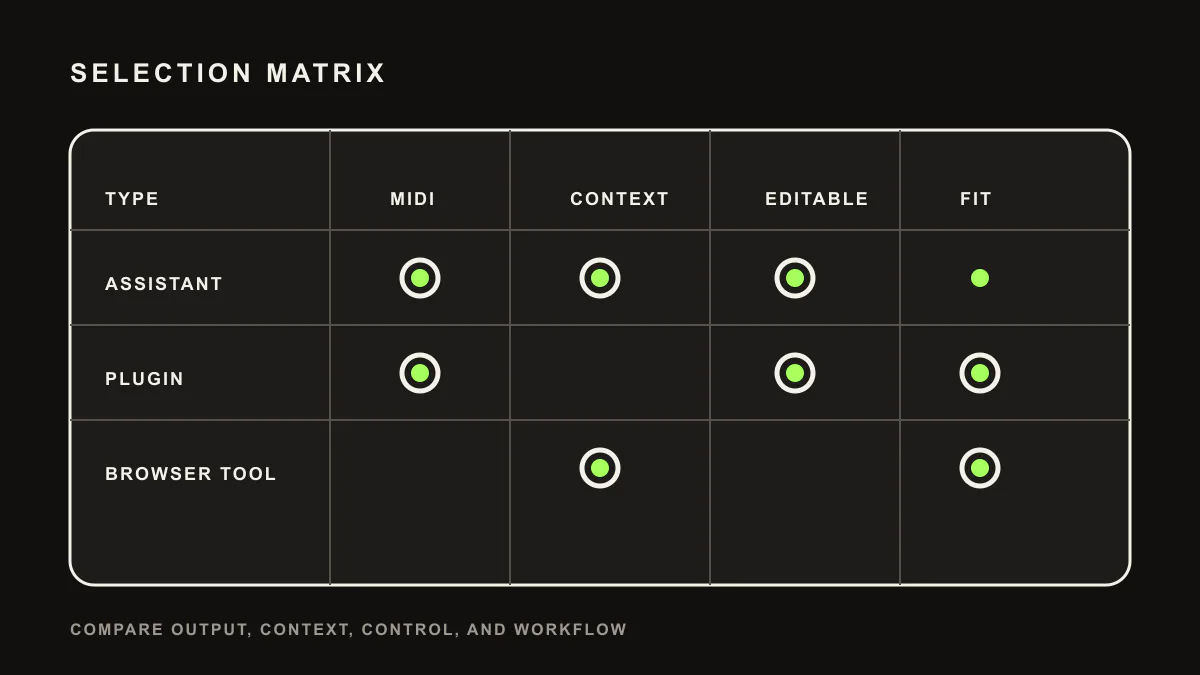
How We Tested
This roundup was put together in May 2026 based on hands-on use, vendor documentation, and public pricing pages current as of the same month. Each tool was evaluated against the same set of producer needs: in-DAW execution, waitlist clarity, language support, mobile and remote control, MIDI generation, sound design, voice control, mix suggestions, free tier, setup friction, privacy posture, and license model. Pricing reflects the rates published on each vendor site at the time of writing.
Disclosure: LIA is the AI assistant we build, so we have the deepest hands-on experience there. For competitor tools we relied on documented features, public demos, official launch coverage from outlets like MusicTech and Attack Magazine, and free-tier testing during March-May 2026. If a competitor row below is out of date, please email contact@liaplugin.com and we will update.
Side-by-Side: LIA vs Major Alternatives (May 2026)
The matrix below compares LIA against the five most-cited Ableton-aware AI tools we encountered. Magenta Studio is included as the open-source baseline; the four commercial alternatives are the most visible in 2026 SERP for "AI assistant Ableton" and "natural language Ableton control". LIA rows reflect current shipped behavior; every competitor cell reflects public information as of June 2026, so check each vendor for the latest terms.
| Capability | LIA | AbletonGPT | Jamu | Mozart AI | MIDI Agent | Magenta Studio |
|---|---|---|---|---|---|---|
| Works inside Ableton session | Yes (LIA Bridge) | Yes (native macOS and Windows app) | Yes | Web tool, MIDI export | Yes (plugin) | Yes (Max for Live) |
| Other DAW waitlist | Waitlist updates, no promised date | Ableton only | Ableton only | DAW-agnostic export | Ableton only | Ableton only |
| Multi-language interface | 10 languages (EN, IT, DE, ES, FR, NL, PT, JA, KO, ZH) | English | English | English | English | English |
| Mobile / remote control | Yes (browser + web app, Pro+) | No | No | Web only | No | No |
| MIDI generation | In-session, fully editable | In-session | In-session | Cloud-rendered MIDI | In-session | In-session (Continue / Generate / Drumify) |
| Sound design + preset loading | Yes (instruments, racks, presets) | Limited | Yes | No | No | No |
| Voice control | Yes for push-to-talk from Starter up; Realtime Talk Mode is planned for launch from Studio up | Yes (voice dictation, v2.5) | No | No | No | No |
| Mixing + effects automation | Yes (EQ, comp, dynamic movement idea, sends) | Limited | Yes | No | No | No |
| Free tier | Yes (10 trial productions) | No free tier (Beta, Pro, Max all paid) | Free trial | Limited free | No free trial | Free, open source |
| Setup difficulty | Bridge installer, ~2 min | Desktop app install | Easy | Web-based | Plugin install | Max for Live install (M4L required) |
| Privacy: where audio lives | Local DAW (LIA reads metadata, never uploads audio or full project) | Cloud (chat content) | Cloud | Cloud | Local plugin | Local (TensorFlow on-device) |
| Open source | No | No | No | No | No | Yes (Magenta library) |
Need an alternative angle? See also our deeper dive on AI MIDI generation tools for Ableton, the broader best AI assistants for music production 2026 roundup, the full 10 best AI plugins for music production guide, and the best AI tools for FL Studio.
Why an AI Assistant Is the Best Fit for Ableton Producers
If you produce music in Ableton, an AI assistant gives you the most leverage. Here is why:
You keep full control. Every MIDI note, every effect parameter, every mixer setting is editable. The AI builds the scaffolding; you refine the result. This is the opposite of a generator, where the output is a black box.
It accelerates repetitive work. Setting up a session structure, loading instruments, creating basic drum patterns, organizing buses, applying dynamic movement idea. These are tasks that eat time without requiring creative decisions. An assistant handles them in seconds.
It uses your sound. Because the assistant works inside your Ableton session, it loads your VSTs, your samples, your presets. The output sounds like you, not like a generic AI model.
It scales with your skill. Beginners can describe what they want in plain language and get a working session. Advanced producers can use it as a co-pilot, asking for specific techniques, complex routings, or rapid A/B comparisons that would take minutes to set up manually.
LIA: The AI Assistant Built for Ableton Live
LIA is an AI assistant that connects to your Ableton Live session and executes directly in that session. You chat with LIA in your browser. LIA helps create editable MIDI, organize tracks, and suggest reachable session or mix moves where supported. The same family of natural-language-to-DAW workflows that producers explored throughout 2026 (see for example Daniel Raffel's MCP setup walkthrough) is what LIA delivers without the terminal-and-Python install friction.
How It Works
LIA runs through a lightweight local bridge (LIA Bridge) that sits between your browser and Ableton Live. The bridge runs on your Mac or PC and connects to your local Ableton session. Your projects never leave your computer. LIA Bridge only sends control commands.
- Install LIA Bridge on your Mac or Windows machine. Setup takes under 2 minutes.
- Open Ableton Live (version 12 or later, any edition) and start a new session or open an existing one.
- Chat with LIA in your browser. Describe what you want. LIA builds it.
What LIA Can Do
- Beat creation: full drum patterns from a prompt, using your drum racks or instruments
- MIDI generation: melodies, basslines, chord progressions, all editable note-by-note
- Track building: create and organize multiple tracks, groups, and buses automatically
- Mix suggestions: receive level, panning, EQ, compression, reverb, and delay ideas you decide whether to use
- Sound design direction: shape synth or sound choices through editable, producer-controlled prompts
- Session organization: rename tracks, color-code groups, mute/solo, set up arrangements
- Effect direction: get reachable effect and parameter suggestions where supported
Ten Languages
You can prompt LIA in 10 languages. The interface and conversation support English, Italian, German, Spanish, French, Portuguese, Dutch, Japanese, Korean, and Chinese.
Remote Control (Pro+)
With a premium plan, you can control your Ableton session from any device. Open LIA on your phone, tablet, or another computer, and it connects to your Ableton running at home. Sketch a beat on the train, review mix suggestions from the couch, or prep a session before you reach the studio. No VPN, no port forwarding, no extra setup. Your Ableton just needs to be open with LIA Bridge running.
Pricing
LIA offers a generous free tier to get started with no credit card required, plus premium plans for producers who need more power and advanced AI models. Check out the latest plans at liaplugin.com/pricing.
Mix Suggestions and Sound Direction, Not Just Composition
Most producers think of AI as a composition tool, but LIA also helps with suggestion-level production decisions. You can ask for EQ, compression, reverb, delay, or saturation ideas, then decide what to apply and refine in Ableton. This makes LIA useful even in sessions where the musical idea exists and you want another set of starting points.
What to Look for in an AI Tool for Ableton
Before committing to any AI tool, run through this checklist:
- Does it work inside your Ableton session, or does it produce a separate file?
- Is the output editable? Can you change individual MIDI notes, effects, or mix settings?
- Does it use your existing plugins, instruments, and samples?
- Do you own 100% of the output, with no licensing restrictions on streaming or distribution?
- Does it offer mix suggestions and reachable effect guidance, not just composition?
- Can you communicate in your preferred language?
- Is there a free tier so you can test before paying?
- Does your data stay on your machine?
If a tool checks all of these boxes, it is designed for serious Ableton producers. If it misses several, it may be better suited for quick demos than for real production work.
Conclusion
AI tools for Ableton Live fall into two categories with fundamentally different tradeoffs. Generators are fast but inflexible. Assistants offer broader workflow support: they work inside your session, produce editable output, use your instruments, and help with everything from beat creation to suggestion-level mix decisions.
For producers who want to accelerate their workflow without giving up creative control, an AI assistant is the strongest choice. LIA is built specifically for this purpose: it connects to your Ableton session, speaks your language, and gives you back the time you would otherwise spend on repetitive setup and technical tasks.
Frequently asked questions
Are there free AI tools for Ableton Live?
Yes. LIA has a Free plan with 10 total trial productions. Magenta Studio is fully free and open source. Jamu and Mozart AI offer free tiers you can test before committing. AbletonGPT (now Yuma) has no free tier; its Beta, Pro, and Max plans are all paid, and MIDI Agent is a paid one-time purchase (competitor facts as of June 2026).
Which AI tools work offline or with my own LLM key?
Magenta Studio runs entirely offline since it uses local TensorFlow models. LIA Bridge runs locally for DAW control, but the AI prompt routing requires an internet connection to the LIA service. AbletonGPT, Jamu, Mozart AI, and MIDI Agent are cloud-based.
Can I use these AI tools commercially? Are there licensing issues?
Output from AI assistants like LIA, AbletonGPT, Jamu, and MIDI Agent belongs to you, the same as any MIDI you would write manually. AI generators like Suno and Udio carry per-provider licensing terms that may restrict streaming distribution. Magenta Studio output is yours under the project's permissive license.