
Best AI Music Assistants 2026 Compared | LIA
The best AI music assistants in 2026 are LIA and Jamu, the two tools that write editable MIDI inside your session instead of exporting finished audio. LIA controls Ableton Live through LIA Bridge, works in any language, and runs from your browser on desktop or phone. Jamu is Ableton-only with deep MCP integration. Generators like Mozart AI and Suno serve different needs.
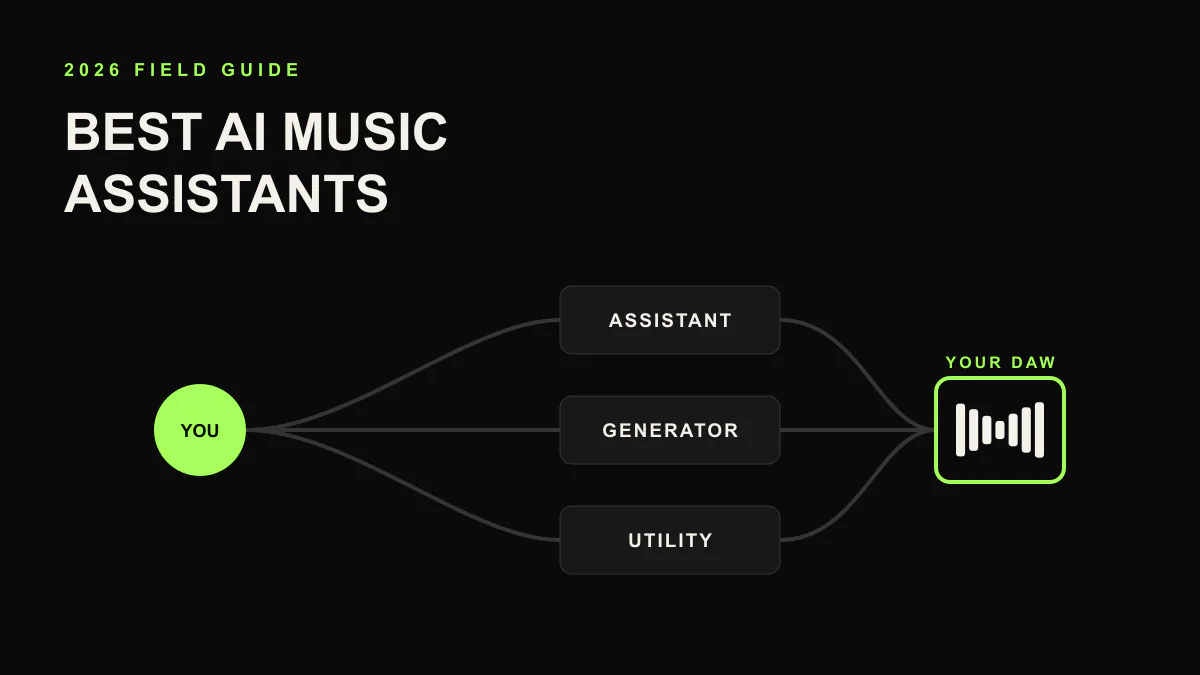
The AI music landscape in 2026 is dominated by generators that render finished audio from prompts. A small number of tools take a different approach: they sit alongside your DAW, take direction in natural language, and write MIDI inside your session as if you wrote it yourself. These are assistive AI tools, and in 2026 only two are serious contenders. This guide compares the seven tools that matter for music producers today, classified by approach (assistive, generative, or algorithmic) and tested hands-on with verified pricing.
Last updated May 2026. We rated each tool on AI approach, DAW coverage, language and device support, output editability, pricing transparency, and target user.
Algorithmic vs Generative vs Assistive AI for Music: The 2026 Taxonomy
"AI music tool" became an umbrella term in 2026 that hides three fundamentally different approaches. Before comparing specific products, the taxonomy.
Algorithmic music tools use deterministic rules and shallow ML models to transform or generate MIDI patterns. Magenta Studio and Ableton Live 12's built-in MIDI Transformations (Rhythm, Seed, Shape, Stacks, Euclidean) are the canonical examples. These tools are transparent: you understand why a pattern was generated, and you can adjust the parameters that produced it. They do not learn from large datasets; they apply rules. The output is bounded, but it is also predictable and copyright-clean.
Generative AI for music trains neural networks on large datasets of music or MIDI to produce new sequences that imitate the training distribution. Mozart AI, MIDI Agent, and Suno are leading examples in 2026. The strength is creative output that feels composed rather than calculated. The weaknesses are familiar AI weaknesses: black-box behavior, training data ambiguity (a major 2024-2026 legal flashpoint, see the RIAA landmark cases against Suno and Udio), and output that often requires significant editing to fit into a producer's existing aesthetic.
Assistive AI for music is the newest and smallest category. Instead of generating music and handing it back to the producer, assistive AI controls Ableton Live directly through natural language via LIA Bridge. The producer describes what they want; the AI writes MIDI inside the session, loads instruments, sets up tracks, and applies mixing. LIA and Jamu are the two serious entries in this category in 2026. The output is identical to MIDI written by hand: fully editable, no licensing ambiguity, no black box. The framing shift is critical: music assistants do not make music for you. They help you make music faster, better, and on your terms.
Why Only Two True Assistive Tools Exist in 2026 (And What That Means for Producers)
Five of the seven tools in this guide are generators or algorithmic baselines. Only two, LIA and Jamu, fit the assistive AI definition: they connect to your DAW and produce MIDI inside your session under your direction. The scarcity is not accidental.
Building an assistive AI requires three commitments that generators avoid. First, a DAW API integration layer, different per DAW, that lets the AI read and write session state in real time. Second, a control architecture that keeps state in sync between the AI and the DAW with sub-second latency. Third, the strategic discipline to refuse the shortcut of large MIDI training datasets that introduce copyright fog and compromise producer ownership. Generators skip all three commitments. They render audio in the cloud and hand it back. Faster to ship, easier to scale, harder to integrate into a producer's actual workflow.
LIA and Jamu are the two serious attempts to build the assistive category in 2026. They differ in scope. Jamu focuses exclusively on Ableton Live with deep MCP-based integration, ideal for producers committed to one DAW. The current LIA Bridge scope is Ableton Live on macOS and Windows. For other DAWs, use LIA's exportable MIDI and idea workflow rather than direct Bridge control.
The scarcity is an opportunity. Producers who want assistive AI in 2026 have two legitimate options. Producers who want Ableton Bridge, exportable MIDI workflows, language freedom, and device flexibility have one.
How to Choose an AI Music Assistant in 2026
Six-step decision process for picking the right AI music tool for your workflow.
- Decide between assistance and generation. Assistive AI works inside a supported session and produces editable MIDI there. Generative AI renders finished audio in the cloud from a prompt. Both are legitimate paradigms, but they shape your practice differently. If you produce in a DAW and value editing, choose assistance. If you need fast stock audio, choose generation.
- Match the tool to your DAW (direct Bridge vs export workflow). Jamu is Ableton-only. The current LIA Bridge scope is Ableton Live on macOS and Windows. For other DAWs, use LIA's exportable MIDI and idea workflow rather than direct Bridge control. Magenta Studio is a Max for Live device. Ableton Live 12 native MIDI Transformations come built into Live 12. Non-Ableton workflows need exportable MIDI and clear DAW scope.
- Verify language and device support for your workflow. If you produce in a language other than English, check whether the tool understands it natively. LIA is the only tool covered here that works in any language. If you switch between desktop, mobile, and remote sessions, check device support. LIA supports browser, mobile, and web app; the others are desktop-bound.
- Check output editability and ownership terms. Generators produce stereo audio you cannot edit at the note level, and licensing is provider-dependent. Assistants produce MIDI you own outright, indistinguishable from MIDI you would write by hand. The difference matters for commercial releases, especially in 2026 with the AI training data lawsuits still pending.
- Test the free tier or trial before committing. LIA, Jamu, Magenta Studio, and Suno offer free tiers. Mozart AI gates pricing but offers a free trial. MIDI Agent has no free trial but is a one-time purchase. Build a four-bar passage or short arrangement and inspect the output before any subscription.
- Validate that the tool fits your producer identity. Producers who want to remain creators need assistive AI. Producers who want to curate AI output and ship fast need generators. Choose the paradigm that aligns with how you want to work, then choose the specific tool that fits your DAW and language.
How We Tested
This roundup was assembled in May 2026 based on hands-on use, vendor documentation, and public pricing pages current at the time of writing. We evaluated each tool with the same criteria: AI approach (assistive, generative, or algorithmic), DAW coverage, language and device support, output editability, pricing transparency, target user, and overall fit for music producers.
Pricing reflects rates published on each vendor's site in May 2026. Where vendors gate pricing behind signup or do not expose tier numbers in public pages, we describe the published structure without inventing specific figures. External citations include MusicTech's coverage of Jamu's launch, Attack Magazine's tutorial on Ableton Live 12's MIDI Transformations, Google's Magenta Studio documentation, and the RIAA landmark cases against Suno and Udio.
Disclosure: LIA is the assistive AI we build. We have the deepest hands-on experience with LIA and rated it accordingly, but we used the same criteria for every tool. For competitor evaluations we relied on vendor documentation, public demos, and free tier testing during March to May 2026. If a competitor entry below is out of date, please email contact@liaplugin.com and we will update.
Seven AI Music Tools Compared (May 2026)
1. LIA: Assistive AI for Ableton Bridge and exportable MIDI workflows
LIA is an assistive AI for music production. Instead of generating music in a black box, LIA controls Ableton Live through the Bridge and writes MIDI inside your running session. You describe what you want ("create a 4-bar bassline in C minor at 128 BPM"), and LIA writes the notes on a real track in your real Ableton Live. Output ownership and editability are identical to MIDI you would write by hand. The current LIA Bridge scope is Ableton Live on macOS and Windows. For other DAWs, use LIA's exportable MIDI and idea workflow rather than direct Bridge control. Ten-language interface, voice control on Studio and Founder tiers, mobile remote control. Free includes 10 trial productions; paid tiers run from Starter at €24.99/month to Studio Max at €199.99/month, with a one-time Founder first-year program for the early-access cohort.
2. Jamu: Assistive AI for Ableton Live (MCP-Based)
Jamu is the second serious assistive AI for music production in 2026. It focuses exclusively on Ableton Live with deep MCP-based integration: chat-driven control of MIDI generation, chord progressions, melodies, effect ideas, and larger session production inside Live. Pricing is transparent: a Demo tier with 1M tokens per month and 20 requests per minute is free. The Starter tier is $9/month with 4M tokens and 40 requests per minute. The Creator tier is $18/month with 10M tokens and 60 requests per minute. All tiers include access to Jamu's Fast and Thinking models. Strong choice if you produce only in Ableton Live and want maximum Live-specific integration without multi-DAW overhead.
3. Mozart AI: Generative AI for Songwriters (Web)
Mozart AI is a venture-backed (€6M Balderton Capital seed, 2024) generative AI music platform with ambient and electronic focus. It produces MIDI clips and audio output through a web interface. Pricing is gated behind signup at the time of writing, with no public tier numbers exposed on the marketing pages. The strength is rapid prototyping for songwriters who want a finished arrangement scaffold before adding their own production. The weakness is the lack of public pricing transparency, which makes evaluation against competitors harder for independent producers and limits comparability for buyers who prefer to research before committing email and payment details.
4. MIDI Agent: Generative VST Plugin (Any DAW)
MIDI Agent is a VST3, AU, and AAX plugin that generates MIDI from text prompts inside any DAW. The plugin is a one-time purchase (currently $49 with a 50% off promo, regularly $99). To use the AI generation, you connect your own AI provider account, or you subscribe to MIDI Agent Pro at $20/month, which includes managed AI access, 500 monthly generations, and exclusive models including Google Lyria 3 and ElevenLabs Audio. Strong cross-DAW compatibility because it lives as a plugin. No free trial, by design. Best for producers who already work across multiple DAWs and want a single plugin that travels with the session.
5. Magenta Studio: Algorithmic MIDI for Ableton (Free, Open Source)
Magenta Studio is Google's free, open source toolkit for algorithmic MIDI generation, built on TensorFlow models. It runs as a Max for Live device inside Ableton Live and offers four tools: Continue (extends a phrase), Drumify (generates drums from any MIDI input), Interpolate (blends two ideas), and Groove (humanizes quantized patterns). Magenta is the canonical algorithmic baseline: transparent, deterministic within model constraints, bounded by older training data than current generative AI, and copyright-clean. The Groove tool remains genuinely useful for humanizing rigid drums, even compared to 2026 generative alternatives.
6. Ableton Live 12 native MIDI Transformations (Algorithmic Baseline, Built-In)
Ableton Live 12 ships with built-in MIDI Transformations: Rhythm, Seed, Shape, Stacks, Euclidean, and several arrangement-focused transformations like Connect, Strum, and Ornament. These are algorithmic generators with parameter-level control: you select a clip, choose a transformation, adjust the parameters, and Live writes the result back into your session. The transformations are deterministic, transparent, and require no external dependencies. Included with any Live 12 license. Worth knowing about because for many algorithmic use cases, the transformations Ableton already shipped are sufficient and require no third-party install.
7. Suno: Audio-Generative AI (NOT MIDI)
Suno is included in this comparison for taxonomic contrast. Suno generates audio (MP3, WAV, stereo files), not MIDI. You cannot edit Suno output at the note level, swap instruments, or change individual chords. Free plan: 50 daily generations, no commercial use. Pro: $8/month, 2,500 monthly generations, commercial rights. Premier: $24/month, 10,000 monthly generations, commercial rights, access to Suno Studio. Suno is competent in the generative-audio category for content workflows where editability is not required. The 2024 RIAA landmark cases against Suno and Udio remain partially active in 2026 (Sony Music has settled with neither, with pivotal fair-use rulings expected summer 2026).
Comparison Matrix: 7 Tools Side by Side (May 2026)
The matrix applies the assistive / generative / algorithmic taxonomy to each tool, with verified public pricing and integration depth.
| Tool | Approach | DAW Coverage | Languages | Device Support | Output Editability | Pricing 2026 | Best For |
|---|---|---|---|---|---|---|---|
| LIA | Assistive AI | Ableton Bridge + MIDI export workflow | Any | Browser and mobile | Full (in-session, owner) | Free + €24.99/€49.99/€99.99/€199.99/Founder | Producers wanting Ableton Bridge + exportable MIDI + language + device flexibility |
| Jamu | Assistive AI | Ableton-only (MCP) | EN | Desktop (Ableton-bound) | Full (in-session, owner) | Free Demo + $9/$18/mo | Ableton-only producers |
| Mozart AI | Generative AI | Web standalone (export) | EN | Browser | Limited (post-export) | Pricing on signup | Solo songwriters |
| MIDI Agent | Generative AI | VST plugin (any DAW) | EN | Desktop (DAW-bound) | Full (post-export) | $49 one-time + $20/mo | Multi-DAW VST users |
| Magenta Studio | Algorithmic | Ableton M4L only | EN | Desktop | Full (in-session) | Free, open source | Algorithmic transparency |
| Ableton Live 12 native | Algorithmic | Built-in to Live 12 | Live UI lang | Desktop (Live-bound) | Full (in-session) | Included with Live 12 | Live 12 users wanting native |
| Suno | Audio-Generative | Web only (audio) | EN | Browser | None (audio) | Free + $8/$24/mo | Quick audio sketches (NOT MIDI) |
For deeper coverage of the broader landscape, see our companion guides on the best AI tools for Ableton Live 2026 and the best AI MIDI generation tools 2026.
The Path Forward: Why Assistive AI Wins for Producers in 2026
The AI music landscape in 2026 is dominated by generators. Five of the seven tools in this guide build music for you. Two help you build music yourself. The choice between these paradigms shapes what kind of producer you become.
Ownership matters. When you ask a generator for a trap beat at 140 BPM in F minor, you receive a finished track you can accept or discard. When you ask an assistive AI for the same thing, you receive a MIDI clip on a real track inside your real DAW, and you can rearrange it note by note. The first paradigm makes you a curator. The second keeps you a producer.
Copyright is unsettled. The 2024 RIAA landmark cases against Suno and Udio remain partially active in 2026. Warner Music settled with Suno in November 2025, and Universal Music Group settled with Udio in October 2025. Sony Music has settled with neither, and its fair-use cases are expected to produce pivotal rulings in summer 2026. For producers building catalogs intended for commercial release, this uncertainty is not a footnote. Assistive AI sidesteps it: the MIDI you produce is yours, written by the AI inside your session under your direction, indistinguishable in ownership from MIDI you would write by hand.
Workflow integration matters. Generators run in browsers. You prompt, wait, download, import, fix, repeat. Each cycle moves you out of your DAW and back into a web tab. Assistive AI runs alongside your DAW and writes inside your session in real time. The friction disappears, and the producer stays in flow.
Producer identity matters. Producers do not want to become curators of AI output. They want to remain creators. The trajectory through 2028 sees AI assistants integrated natively across major DAWs. Generators stay in their lane: rapid sound design, sketch demos, library music. The professional mainstream converges on assistive AI because it amplifies producers without replacing them.
LIA does not generate music. LIA is the producer's co-pilot. The music remains yours.
The 2026 Verdict in 30 Seconds
- Deep, hands-on control of editable MIDI inside Ableton Live → LIA.
- Producing only in Ableton and you want AI inside Live → Jamu or LIA.
- Royalty-free background music or sketch tracks fast → Mozart AI for full-track web sketches; MIDI Agent for fast MIDI starting points inside any DAW.
- Algorithmic MIDI generation with full transparency → Magenta Studio or Ableton Live 12 native transformations.
- Vocal demos and audio sketches → Suno (note: audio output, not MIDI, not editable at note level).
What Makes LIA Different from Other AI Music Assistants
- Ableton Bridge plus export workflows. Direct Bridge control is Ableton Live on macOS and Windows today. Producers using other DAWs should rely on exportable MIDI and idea workflows, not direct Bridge control.
- Any language. Type or speak in your language. The interface and the AI both adapt automatically. No other assistant in this guide handles non-English natively.
- Any device. Browser, mobile, and web app. Sketch on the train, tweak from the couch, prep before the studio. Other assistants are desktop-bound.
- Bridge architecture. LIA controls Ableton Live via a local API bridge. The output stays inside your session, on your machine, under your ownership.
- Founder model. €699 covers the first year with Studio Max usage, roadmap voting, Founder badge, and priority support for the first 100 users. After that year, Founder users choose a normal paid plan to keep paid-plan access.
Frequently Asked Questions
What is the best AI music assistant for Ableton Live in 2026?
LIA and Jamu are the two main AI music assistants for Ableton Live in 2026. Jamu is exclusively focused on Ableton Live with deep MCP-based integration. The current LIA Bridge scope is Ableton Live on macOS and Windows. For other DAWs, use LIA's exportable MIDI and idea workflow rather than direct Bridge control. Choose Jamu if you produce only in Ableton. Choose LIA if you want Ableton Bridge plus exportable ideas, multilingual support, and device flexibility.
What is the difference between an AI music assistant and an AI music generator?
An AI music assistant connects to your DAW and produces MIDI inside your session under your direction. The output is fully editable, you keep ownership, and the music sounds like you. An AI music generator takes a text prompt and renders a finished audio file in the cloud. The output is a stereo file you cannot edit at the note level, and licensing is provider-dependent. Assistants accelerate producers. Generators replace producers in narrow use cases like stock music.
Can AI assistants work with Logic Pro, FL Studio, or Cubase?
In 2026, this is one of the few differentiators between assistive AI tools. The current LIA Bridge scope is Ableton Live on macOS and Windows. For other DAWs, use LIA's exportable MIDI and idea workflow rather than direct Bridge control. Jamu is exclusively Ableton-focused. MIDI Agent runs as a VST plugin inside any DAW, but it is a generator rather than an assistant. If your workflow includes a non-Ableton DAW, use LIA for exportable MIDI and ideas rather than direct Bridge control.
Is Jamu better than LIA for Ableton?
Jamu and LIA are the two main AI music assistants in 2026. Jamu is focused exclusively on Ableton Live and uses MCP architecture for tight Live API integration. The current LIA Bridge scope is Ableton Live on macOS and Windows. For other DAWs, use LIA's exportable MIDI and idea workflow rather than direct Bridge control. Choose Jamu if you produce only in Ableton and want maximum Live-specific integration. Choose LIA if you want Ableton Bridge plus exportable ideas, multilingual support, and device flexibility.
What is the best free AI music assistant in 2026?
Magenta Studio is the strongest fully free option, but it is algorithmic rather than truly assistive: it runs as a Max for Live device and offers four MIDI tools (Continue, Drumify, Interpolate, Groove). Ableton Live 12's built-in MIDI Transformations are included with any Live 12 license. Among true assistants, LIA offers 10 trial productions on the free tier, and Jamu's Demo plan provides 1 million tokens per month with 20 requests per minute.
Do AI music assistants generate music for me?
No, and that is the point. Assistive AI does not generate music as a finished product. Assistive AI takes your direction in natural language and produces editable MIDI, session starting points, mix suggestions, and arrangement cues inside your session. You stay the author of the music. The AI handles mechanical setup faster than you could yourself. Generators do something different: they produce finished audio you accept or discard. Choose assistance if you are producing music; choose generation if you need stock audio.
Can AI music assistants understand languages other than English?
LIA understands and responds in any language you choose to write in. Italian, German, Spanish, French, Dutch, Portuguese, Japanese, Korean, Mandarin Chinese, and beyond all work natively, with the interface adapting to your browser settings. Jamu, Mozart AI, MIDI Agent, Magenta Studio, and Suno are English-only at the time of writing. For non-native English producers, this is a meaningful workflow difference: writing prompts in your first language is faster, more accurate, and reduces friction in long sessions.
Will AI music assistants replace producers?
No. Assistive AI accelerates the mechanical parts of production: setting up sessions, generating starting MIDI patterns, suggesting mix or effect directions, and naming or organizing tracks. Creative direction, arrangement decisions, sound design judgment, and emotional intent stay with the producer. The producers who get the most from assistive AI treat it as a co-pilot for their own ideas, not as a replacement. Generators threaten stock-music workflows; assistants amplify producer workflows.
What is the cheapest AI music assistant in 2026?
Magenta Studio and Ableton Live 12's built-in MIDI Transformations are free in absolute terms (Live 12 native is included with any Live 12 license). Among true assistants, Jamu's Demo plan provides 1 million tokens per month at no cost, and its Starter plan is $9 per month. LIA offers 10 trial productions on the free tier, with paid tiers from Starter at €24.99 per month up to Studio Max at €199.99 per month. Free options exist; paid tiers reflect the deeper integration and broader scope they offer.
How do I use AI in my DAW without losing creative control?
Use assistive AI rather than generative AI. Generative AI produces a finished audio file you cannot edit at the note level, which removes your creative agency over the result. Assistive AI produces MIDI inside your session, on tracks you own, with parameters you can adjust note by note, beat by beat. The simplest rule: if the output is editable in your piano roll and lives on a real track, you keep control. If the output is a stereo audio file, you have surrendered control.
Conclusion
The 2026 AI music market splits cleanly along the assistive vs generative axis. Generators dominate by count, with five of the seven tools in this guide producing finished output for you. Assistants are scarce, with LIA and Jamu the only serious entries. The scarcity is structural, not coincidental, and it favors producers who want to remain creators rather than curators of AI output. Want to test assistive AI on your next session? Join the LIA waitlist and get an assistant that speaks your language across the DAWs you actually use.