
Best AI MIDI Generation Tools 2026: 8 Compared
Short answer: The best AI MIDI generation tools in 2026, by need: LIA for editable MIDI inside Ableton via LIA Bridge (the small helper app that connects LIA to Ableton Live), Magenta Studio as the free open-source baseline, AIVA for orchestral scores, MIDI Agent as a cross-DAW plugin, and AbletonGPT, now rebranded Yuma, for chat-driven Ableton MIDI. Suno makes audio, not MIDI.
"AI MIDI tool" became an umbrella term in 2026 that hides three fundamentally different approaches: algorithmic, generative, and assistive AI. Choosing the wrong category wastes time. Choosing the right one accelerates every session. This guide compares eight tools across that taxonomy, tested hands-on in May 2026 with verified public pricing, and explains which approach fits which workflow.
Last updated May 2026. We rated each tool on AI approach, DAW integration, output editability, language coverage, pricing transparency, and target user.
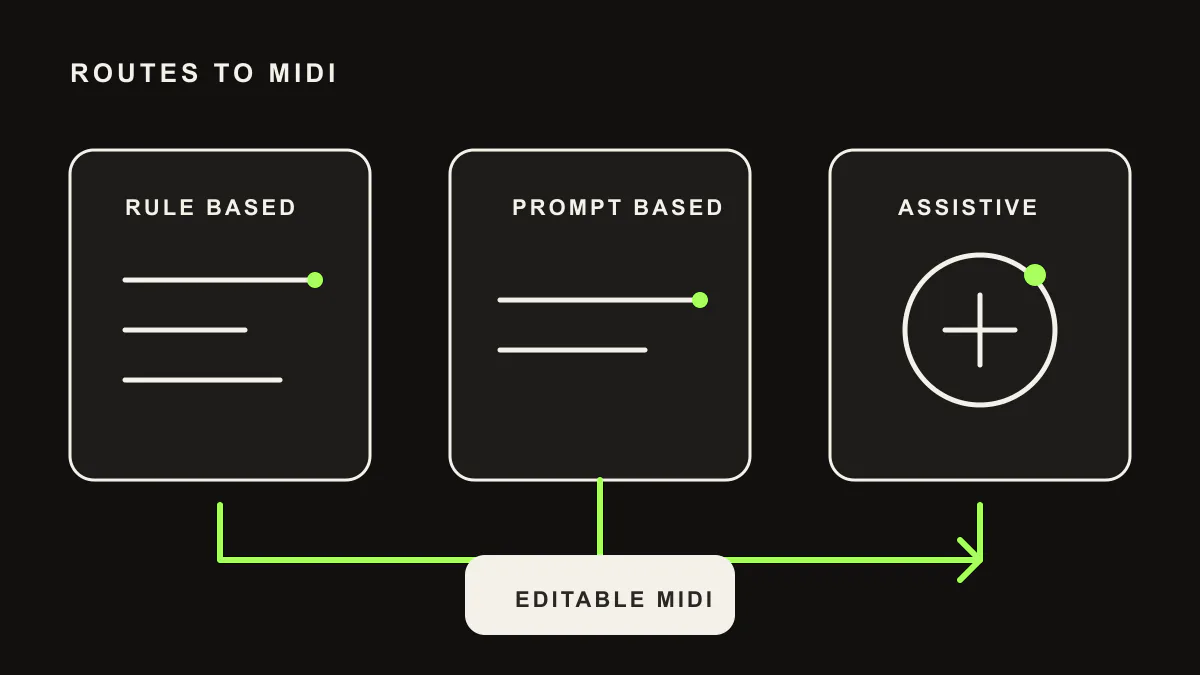
Algorithmic vs Generative vs Assistive AI for MIDI: The 2026 Taxonomy
The umbrella term "AI MIDI tool" hides three fundamentally different approaches. Choosing the right one depends on what you want from the AI: predictable rules, creative output, or workflow acceleration.
Algorithmic MIDI tools use deterministic rules and shallow ML models to generate note patterns from inputs. Magenta Studio and Ableton Live 12's built-in MIDI Transformations (Rhythm, Seed, Shape, Stacks, Euclidean) are the canonical examples. These tools are transparent: you understand why a pattern was generated, and you can adjust the parameters. The trade-off is that output is bounded by the rules. You will not get surprising harmonic ideas, but you also will not get nonsense.
Generative AI for MIDI trains neural networks on large MIDI datasets to produce note sequences that imitate the training distribution. Mozart AI, AIVA, MIDI Agent, and Soundful are the leading examples in 2026. The strength is creative output: melodies and progressions that feel composed rather than calculated. The weaknesses are familiar AI weaknesses: black-box behavior, training data ambiguity, and output that is sometimes difficult to integrate into a producer's existing aesthetic without significant editing.
Assistive AI for MIDI is a newer category. Instead of generating MIDI from scratch and handing it back to the producer, an assistive AI controls Ableton Live directly through natural language via LIA Bridge. The producer describes what they want, and the AI writes MIDI inside the session, loads instruments, sets up tracks, and applies mixing. LIA is the leading assistive AI for music production in 2026. The output is identical to MIDI written manually: fully editable, with no licensing ambiguity, and no black box. The framing shift is critical: assistive AI does not generate music. It helps producers make music faster.
For the rest of this guide we apply this taxonomy explicitly to every tool, so you can match the approach to your workflow rather than buy on hype.
How to Choose an AI MIDI Tool in 2026
This is a six-step decision process for picking the right AI MIDI tool for your workflow.
- Decide if you need generation or assistance. Generative AI creates MIDI from a prompt and hands it to you. Assistive AI works inside a supported session and creates editable MIDI there. If you want creative input from the AI, choose generative. If you want workflow acceleration with full creative control, choose assistive.
- Match the tool to your DAW. Magenta Studio runs natively in Ableton Live as a Max for Live device. AbletonGPT (now Yuma) is Ableton-first with MIDI export to any DAW. MIDI Agent runs as a VST plugin in any host. The current LIA Bridge scope is Ableton Live on macOS and Windows. For other DAWs, use LIA's exportable MIDI and idea workflow rather than direct Bridge control.
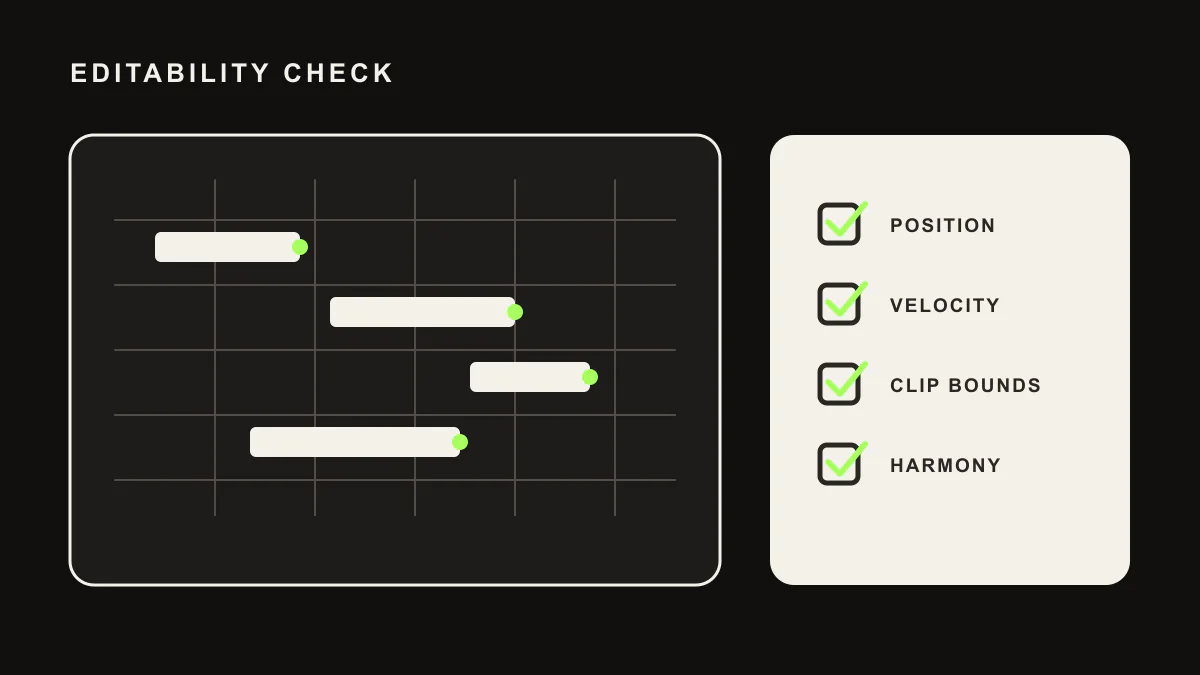
- Test output editability before committing. Generate or build a four-bar passage and inspect the MIDI in your piano roll. Are the note positions on the grid? Are velocities musically appropriate? Are clip boundaries aligned to bars? Tools with messy output cost you more time in cleanup than they save in generation.
- Verify pricing transparency. AIVA, Suno, AbletonGPT (Yuma), and MIDI Agent publish pricing tiers on their websites. Mozart AI and Soundful gate pricing behind signup. Transparent pricing is a signal of operator confidence and lets you compare cost per generation across the market without committing.
- Check the licensing and ownership terms. Read each tool's terms before relying on it commercially. Magenta Studio output is yours under the open source license. AIVA's free tier explicitly retains AIVA copyright; only the Pro plan transfers ownership. Assistive AI tools like LIA produce MIDI you own entirely, identical to MIDI you wrote yourself.
- Build a workflow, not a dependency. The producers who get the most from AI MIDI tools combine multiple approaches: an algorithmic humanizer for rigid drums, a generative tool for cinematic seeds, and an assistive AI for session setup and mixing. Treat them as scaffolding for your own ideas.
How We Tested
This roundup was assembled in May 2026 based on hands-on use, vendor documentation, and public pricing pages current at the time of writing. We evaluated each tool against the same criteria: AI approach (algorithmic, generative, or assistive), DAW integration, output editability, language coverage, pricing transparency, target user, and overall fit for music producers.
Pricing reflects rates published on each vendor website in May 2026. Where vendors gate pricing behind signup or do not expose tier numbers in public pages, we describe the published structure without inventing specific figures. Citations include MusicTech's coverage of Jamu's launch, Attack Magazine's tutorial on Ableton Live 12's algorithmic MIDI tools, and Google's Magenta Studio documentation.
Disclosure: LIA is the assistive AI we build. We have the deepest hands-on experience with LIA and rated it accordingly, but we used the same criteria for every tool. For competitor evaluations we relied on vendor documentation, public demos, and free tier testing during March to May 2026. If a competitor entry below is out of date, please email contact@liaplugin.com and we will update.
Eight AI MIDI Tools Compared (May 2026)
1. LIA: Assistive AI for Ableton Bridge and exportable MIDI workflows
LIA is an assistive AI: instead of generating MIDI in a black box, LIA controls Ableton Live through the Bridge and writes MIDI inside your session. You describe what you want ("create a 4-bar bassline in C minor at 128 BPM"), and LIA writes the notes on a real track in real Ableton Live. The output is identical to MIDI you would write yourself: fully editable, with no licensing ambiguity. The current LIA Bridge scope is Ableton Live on macOS and Windows. For other DAWs, use LIA's exportable MIDI and idea workflow rather than direct Bridge control. Ten-language interface, voice control on Studio and Founder tiers, mobile remote control. Free includes 10 trial productions; paid tiers run from Starter at €24.99/month to Studio Max at €199.99/month, with a one-time Founder first-year program for the early-access cohort.
2. Magenta Studio: Algorithmic MIDI for Ableton (Free, Open Source)
Magenta Studio is Google's free, open source toolkit for algorithmic MIDI generation, built on TensorFlow models. It runs as a Max for Live device inside Ableton Live and offers four tools: Continue (extends a phrase), Drumify (generates drums from any MIDI input), Interpolate (blends two ideas), and Groove (humanizes quantized patterns). Magenta is the canonical algorithmic baseline: transparent, deterministic within model constraints, and bounded by training data older than current generative AI. The Groove tool remains genuinely useful for humanizing rigid drums, even compared to 2026 generative alternatives.
3. AIVA: Generative AI for Orchestral and Cinematic MIDI
AIVA generates multi-instrument MIDI compositions for classical, orchestral, and cinematic styles. Founded in 2016 and continuously developed since, AIVA produces full scores with strings, brass, woodwinds, and percussion, exportable as MIDI for any DAW. Free tier: 3 monthly downloads, AIVA-owned copyright, no monetization, MIDI and MP3 only. Standard plan: €11/month annually billed, 15 monthly downloads, limited monetization on YouTube, Twitch, TikTok, Instagram only. Pro plan: €33/month annually billed, 300 monthly downloads, full ownership transfer, full monetization rights, all file formats including high-quality WAV. AIVA is the strongest dedicated generative tool for composers who need orchestral starting points; less useful for electronic producers focused on beat-driven genres.
4. Mozart AI: Generative AI for Ambient and Electronic
Mozart AI is a venture-backed (€6M Balderton Capital seed, 2024) generative AI music platform with ambient and electronic focus. It produces MIDI clips and audio output through a streamlined web interface. Pricing is gated behind signup at the time of writing, with no public tier numbers. The tool's strength is rapid prototyping for songwriters who want a finished arrangement scaffold before adding their own production. Its weakness is the lack of public pricing transparency, which makes evaluation against competitors harder for independent producers.
5. MIDI Agent: Generative VST Plugin (Any DAW)
MIDI Agent is a VST3, AU, and AAX plugin that generates MIDI from text prompts inside any DAW. The plugin is a one-time purchase (currently $49 with a 50% off promo, regularly $99). To use the AI generation, you either connect your own AI provider account, or you subscribe to MIDI Agent Pro at $20/month, which includes managed AI access, 500 monthly generations, and exclusive models like Google Lyria 3, ElevenLabs, and PozaLabs. Strong cross-DAW compatibility. No free trial, by design. Best for producers who already work across multiple DAWs and want a single plugin that travels with the session.
6. Soundful: Generative AI for Royalty-Free Audio (MIDI Secondary)
Soundful is a generative AI music platform optimized for content creators who need royalty-free music. The free tier provides 1 monthly MP3 download from a 25-style catalog, with no commercial use. Higher tiers (Plus, Pro, Business, Enterprise) unlock more downloads, more styles, STEM packs, and commercial rights, with specific tier pricing visible after signup. MIDI export is available only on Pro and Business tiers, bundled with STEM packs. Soundful is included in this comparison for completeness, but MIDI is a secondary feature, not the primary product. For dedicated MIDI generation, AIVA or MIDI Agent are stronger choices.
7. AbletonGPT (Now Yuma): Assistive AI for Ableton with MIDI Export
Yuma is the current name for the tool formerly called AbletonGPT, so if you searched for "Yuma Studio AI" you are looking at the same chat-driven Ableton assistant covered here. AbletonGPT was rebranded as Yuma in 2026 (the abletongpt.com domain now redirects to yuma.studio). The tool is an assistive AI for Ableton Live: chat-driven control of MIDI generation, chord progressions, melodies, and full track production inside Ableton, plus MIDI export and drag-into-any-DAW workflow. Pricing tiers: Beta one-time $39 for 3,900 generations, Pro $49/month for 5,000 generations, Max $99/month for 10,000 generations. English-only interface. The Ableton-native control depth is comparable to LIA Bridge for Ableton. Support beyond Ableton is limited to MIDI export rather than native control in other DAWs. The current LIA Bridge scope is Ableton Live on macOS and Windows. For other DAWs, use LIA's exportable MIDI and idea workflow rather than direct Bridge control.
8. Suno: Audio-Generative AI (NOT MIDI)
Suno is included in this comparison for taxonomy contrast: it generates audio (MP3, WAV, stereo files), not MIDI. You cannot edit Suno output at the note level, swap instruments, or change individual chords. Free plan: 50 daily generations, no commercial use. Pro: $8/month, 2,500 monthly generations, commercial rights. Premier: $24/month, 10,000 monthly generations, commercial rights, access to Suno Studio. If you want a finished audio file from a prompt, Suno is competent in the generative-audio category. If you want MIDI, choose any of the other seven tools in this guide.
Comparison Matrix: 8 Tools Side by Side (May 2026)
The matrix below applies the algorithmic / generative / assistive taxonomy to every tool, with verified public pricing and integration depth.
| Tool | Approach | DAW Integration | Output Editability | Languages | Pricing 2026 | Best For | Verdict |
|---|---|---|---|---|---|---|---|
| LIA | Assistive AI | Ableton Bridge + MIDI export workflow | Full (in-session) | 10 | Free + €24.99/€49.99/€99.99/€199.99/Founder | Producers wanting full control | Top assistive AI |
| Magenta Studio | Algorithmic | Ableton M4L | Full (in-session) | EN | Free, open source | Algorithmic baseline | Strong free option |
| AIVA | Generative AI | Standalone + MIDI export | Full (post-export) | EN | Free + €11/€33/mo | Film/game composers | Top orchestral generator |
| Mozart AI | Generative AI | Web standalone | Limited (post-export) | EN | Pricing on signup | Solo songwriters | Pricing not public |
| MIDI Agent | Generative AI | VST plugin (any DAW) | Full (post-export) | EN | $49 one-time + $20/mo | Multi-DAW VST users | Best cross-DAW VST |
| Soundful | Generative AI | Web standalone | MIDI in Pro+ only | EN | Free + tiered (signup) | Content creators | MIDI is secondary |
| AbletonGPT (Yuma) | Assistive AI | Ableton + MIDI export | Full (Ableton-side) | EN | $39 one-time + $49/$99/mo | Ableton chat users | Rebranded 2026 |
| Suno | Audio-Generative | Web only (audio) | None (audio) | EN | Free + $8/$24/mo | Audio output only | NOT MIDI; for contrast |
For the broader assistant landscape, see our companion roundup on best AI tools for Ableton Live 2026 and the best AI music assistants 2026 guide. For a deeper look at how AI MIDI fits into the production workflow, see the AI music production guide and the full 10 best AI plugins for music production.
Why Assistive AI Is the 2026 Choice for MIDI Producers
If you produce music in a DAW, an assistive AI gives you the most leverage for MIDI work. The reason is structural: every note, every velocity, every clip boundary stays editable inside your session. The AI builds the scaffolding; you refine the result. This is the opposite of generative AI, where the output is delivered as a clip you can edit afterward but cannot influence in-flight, and it is the opposite of audio generators like Suno, where the output is a stereo file and the note-level layer is gone forever.
Assistive AI also accelerates the parts of MIDI work that are not creative decisions: setting up the session, loading instruments, organizing buses, applying dynamic movement idea, naming and color-coding tracks, organizing export prep. These tasks eat time without producing creative value. An assistant handles them in seconds and leaves your hands free for the choices that matter. See LIA pricing or join the waitlist to test assistive AI on your next session.
Frequently Asked Questions
What is the best AI MIDI generator in 2026?
AIVA is the strongest dedicated generative AI MIDI tool for orchestral and cinematic music. For electronic producers, MIDI Agent (VST in any DAW) and AbletonGPT (now Yuma) are the leading generative options. For producers who want assistance instead of generation, LIA is the leading assistive AI: in its shipped Ableton Bridge workflow, it controls Ableton Live and produces note-level editable MIDI inside your session, identical to MIDI you would write manually.
What is the difference between AI MIDI generation and AI MIDI assistance?
AI MIDI generation creates new note data from a prompt or seed, often via neural network training on MIDI datasets. The output is delivered as a finished clip you can edit afterward. AI MIDI assistance is different: the AI works inside a supported DAW session, and the MIDI is created there as if you wrote it yourself. Editability and ownership are identical to manual MIDI, with no black box.
Can AI generate MIDI that is editable?
Yes. Every tool in this guide outputs standard MIDI files or note data that is fully editable in any DAW piano roll. This is the structural advantage of MIDI tools over AI audio generators like Suno, where the output is a finished stereo file that cannot be edited at the note level. With MIDI, you choose the instrument, modify notes, transpose, quantize, and arrange freely.
Does AI MIDI generation create copyright issues?
The MIDI note data itself rarely meets the threshold for copyright protection because short musical patterns are not original enough to qualify. The full composition you build using AI-generated MIDI as a starting point is your creative work, especially after editing, arranging, and producing. Generative AI tools train on MIDI datasets, and the legal landscape around training data is evolving. Consult a legal professional for commercial releases.
What is the best free AI MIDI tool in 2026?
Magenta Studio is the strongest free option. It is open source, runs offline as a Max for Live device, and includes four MIDI tools: Continue, Drumify, Interpolate, and Groove. AIVA's free tier offers 3 monthly downloads with restrictive licensing. LIA offers 10 trial productions on the free tier, useful for testing assistive AI. Suno offers free daily generations but produces audio, not MIDI.
Can AI MIDI tools work inside Ableton Live?
Yes, with different integration depths. Magenta Studio runs natively as a Max for Live device. AbletonGPT (now Yuma) controls Ableton via chat. LIA connects through LIA Bridge for direct in-session control. MIDI Agent loads as a VST plugin in Ableton like any other plugin. AIVA, Mozart AI, and Soundful are external tools that export MIDI files you import into Ableton manually.
Is Mozart AI better than AIVA for MIDI?
They serve different use cases. AIVA targets orchestral and cinematic composition with multi-instrument MIDI scores, useful for film and game composers. Mozart AI targets ambient and electronic styles with a streamlined web workflow. AIVA has a transparent free tier (3 downloads per month, MIDI included) and clear pricing. Mozart AI's pricing is gated behind signup. For independent producers, AIVA offers more public information for evaluation.
What is LIA and how is it different from generative AI MIDI tools?
LIA is an assistive AI for music production. Where generative tools create MIDI from scratch and hand it back to you, LIA controls Ableton Live through Bridge: you describe what you want, and LIA writes MIDI inside the supported session. The output is identical to MIDI you would write manually. There is no black box, no licensing ambiguity, and full note-level editability.
Do professional producers use AI MIDI tools?
Increasingly, yes, but selectively. Professional electronic producers use Magenta Studio's Groove tool for humanizing rigid patterns and AIVA for cinematic starting points in scoring projects. Few professionals rely entirely on generative AI for primary composition because the output requires significant editing to fit a specific aesthetic. Assistive AI like LIA sees more professional use because it accelerates session setup, mixing, and arrangement without replacing creative decisions.
Will AI replace MIDI composers?
No. AI accelerates repetitive parts of MIDI composition, like generating rhythmic placeholders, harmonizing chord progressions, or humanizing quantized patterns. Creative direction, emotional intent, arrangement decisions, and sound design judgment remain human work. The producers who benefit most from AI MIDI tools are those who treat them as fast scaffolding for their own ideas, not as autonomous composers. The collaboration model is human plus AI, not AI alone.
Conclusion: Match the Approach to Your Workflow
The most useful framing for AI MIDI tools in 2026 is the algorithmic vs generative vs assistive taxonomy. Algorithmic tools like Magenta Studio give you transparent rule-based output. Generative AI tools like AIVA, Mozart AI, MIDI Agent, and Soundful give you creative neural-network output. Assistive AI like LIA gives you workflow acceleration with full creative control.
Most producers will use combinations of these approaches across different parts of a session. There is no single best tool for every workflow, but there is a best approach for every workflow once you know the taxonomy. Want assistive AI that controls Ableton Live through Bridge and produces note-level editable MIDI inside your session? Join the LIA waitlist and get an assistant that speaks your language.