
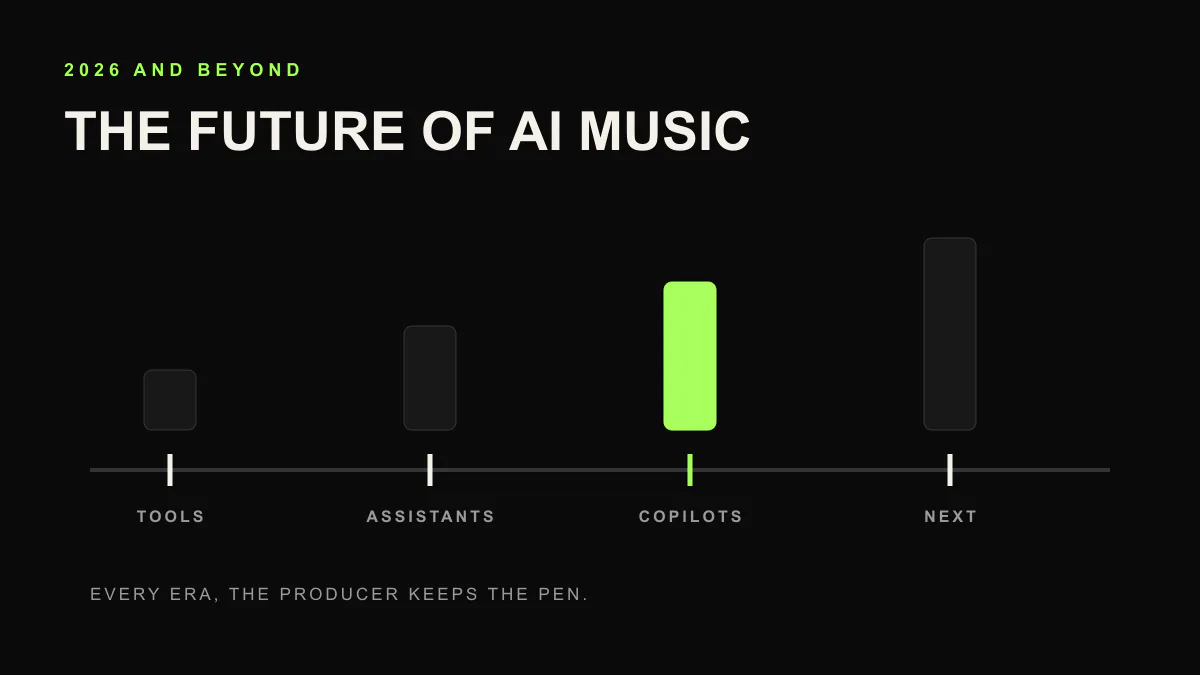
The Future of AI in Music Production (2026)
Music production has always evolved alongside technology. Multitrack recording, MIDI, digital audio workstations, software synthesizers. Each wave of innovation changed how producers work while keeping the fundamental creative process intact. AI is the latest wave, and it's arguably the most significant since the invention of the DAW itself.
But unlike previous shifts, AI in music production isn't following a single path. The technology is branching in several directions at once, and in 2026, we're starting to see which branches will define the next decade. Let's look at where things stand, what's actually working, and where the industry is headed.
For current survey findings and market baselines, see our sourced music production statistics, with linked primary sources and downloadable chart images.
The Shift from Generators to Assistants
The first wave of AI music tools focused on generation. Services like Suno and Udio captured mainstream attention by producing complete songs from text prompts. The results were impressive as a technology demonstration, but the music industry quickly realized that generation alone doesn't serve the needs of working producers.
Producers don't want finished songs they can't edit. They want tools that help them work faster within their existing creative process. This realization has driven a fundamental shift in how AI music tools are being built.
The emerging model is the AI assistant: software that understands your DAW, responds to natural language, and performs actions within your session. Instead of producing a flat audio file, an assistant creates MIDI notes you can edit, loads instruments you can tweak, and adjusts mix parameters you can override. You stay in control. The AI handles the tedious parts.
LIA represents this assistant model. It doesn't generate music outside your DAW. It works inside your session, translating your creative intentions into DAW actions. This approach preserves everything producers care about: editability, sonic identity, ownership, and creative control.
DAW Scope: Honest Boundaries Matter
One of the most important lessons for AI music tools is that DAW integration cannot be hand-waved. Historically, every tool in music production has been built for specific platforms. Some plugins only work in Pro Tools. Some controllers only support Ableton. This fragmentation has always been a real workflow issue.
LIA's current Bridge scope is Ableton Live on macOS and Windows. Other DAWs belong in waitlist and update channels until direct integration actually ships. That boundary keeps the product honest and keeps producers from expecting live control where it does not exist yet.
Producers outside Ableton can still use assistant output as exportable MIDI, ideas, and production notes. That is useful, but it is not the same thing as live Bridge control inside every DAW.
Voice Control: Talking to Your DAW
Typing commands to an AI assistant is already a significant improvement over clicking through menus and parameters. But the next step is voice control, and it's closer than most people think.
Imagine being in the middle of a recording session, hands on your keyboard or guitar, and saying "LIA, loop the last four bars and add a gentle reverb to the vocal." No reaching for the mouse. No breaking your creative flow. The AI hears your request and executes it while you keep playing.
Voice control isn't just about convenience. It changes the relationship between the producer and the DAW. Instead of the software being something you operate with precise inputs, it becomes something you collaborate with through conversation. The interaction starts to feel less like using a tool and more like working with a knowledgeable assistant who happens to have perfect recall and instant execution speed.
The technical challenges are real. Voice recognition needs to be accurate in noisy studio environments. The AI needs to understand context (does "make it louder" mean the selected track, the main output, or the last thing I mentioned?). Latency needs to be low enough that the response feels immediate. But these are engineering problems, not fundamental barriers, and they're being solved rapidly.
AI That Learns Your Style
Right now, most AI music tools treat every user the same. You get the same suggestions whether you're a trap producer or a jazz composer. That's changing.
The next generation of AI assistants will learn from your behavior. Not by analyzing your audio (which raises copyright concerns) but by observing your workflow patterns. If you always start a session by loading a particular drum kit and setting the tempo to 140, the AI can anticipate that. If you consistently reach for certain chord voicings or mixing techniques, the AI can suggest those first instead of generic options.
This personalization is powerful because it means the AI gets better the more you use it. Over time, it becomes attuned to your specific creative preferences, your favorite instruments, your go to processing chains, your arrangement habits. It becomes your assistant, not just an assistant.
The privacy implications need to be handled thoughtfully. Producers need to know exactly what data is being collected, how it's stored, and whether it can be deleted. Transparency here isn't optional. It's essential for trust.
Collaboration Features: AI as the Bridge
Music production has become increasingly collaborative, with producers sending stems and projects across the globe. AI assistants could play a fascinating role here as intermediaries between collaborators.
Picture this: you're working on a track in Ableton and your collaborator is in Logic Pro. Instead of organizing export prep, sending files, and hoping everything lines up, you could share your LIA session. Your collaborator's AI assistant understands the structure, instrumentation, and intent of your session and can translate it into their DAW environment. They make changes, and the AI keeps everything synchronized.
This is admittedly more vision than reality right now. The current practical path is narrower: ship one DAW integration well, make outputs portable where possible, and keep waitlist language clear until other integrations are real.
Local AI Processing: Privacy and Speed
Today, most AI tools rely on cloud processing. Your request goes to a server, gets processed, and the result comes back. This works fine for text based interactions, but it introduces latency and requires an internet connection.
The trend toward local AI processing is significant for music production. Modern laptops and desktops, especially those with dedicated neural processing hardware, are becoming capable of running sophisticated AI models locally. Apple's M series chips, NVIDIA's consumer GPUs, and dedicated AI accelerators are all pushing this forward.
Local processing means near instant response times, no internet dependency, and complete privacy. Your session data never leaves your computer. For professional studios handling unreleased material, this is not a nice to have. It's a requirement.
We'll likely see a hybrid model emerge: simple, quick commands processed locally for instant response, while more complex requests (like generating entire arrangements) use cloud processing for better results.
Will AI Replace Producers?
Let's address this directly, because it comes up in every conversation about AI and music. No, AI will not replace producers. Here's why.
Music production is ultimately about making creative decisions. Which chord feels right here? Should the drop hit harder or should we pull back? Does this vocal take have the right emotion? These are human judgments rooted in taste, experience, and artistic vision. AI can suggest options, but it can't feel what works.
What AI will replace is the mechanical work of production. The hours spent searching for the right preset. The tedious MIDI editing. The repetitive mixing adjustments. The organizational busywork of managing large sessions. This is the work that slows producers down without contributing to the creative vision.
Think of it like this: word processors didn't replace writers. Spell check and grammar tools didn't eliminate the need for good writing. They removed friction, letting writers focus on what matters: the ideas, the story, the voice. AI in music production is following the same pattern.
The producers who thrive will be those who use AI to amplify their unique creative voice rather than outsourcing their creativity to it. The tool changes. The art doesn't.
What's Real Now vs. What's Coming
Let's be honest about where things stand in 2026:
What's real right now:
- AI assistants that control your DAW via natural language (LIA for Ableton Live)
- AI powered mixing and release prep tools (iZotope, Sonible)
- Intelligent composition aids (Scaler, Captain Plugins)
- AI cleanup and restoration tools
- AI music generators for quick demos and content
What's actively being built:
- Clear DAW scope and waitlist channels for AI assistants
- Voice controlled DAW interaction
- Personalized AI that learns your workflow
- Local AI processing for speed and privacy
What's further out:
- Seamless cross DAW collaboration through AI
- AI that anticipates your next creative move
- Full voice only production sessions
- AI assistants that understand emotional and cultural context deeply
The Vision
The future of AI in music production isn't about replacing the human element. It's about removing the barriers between a musical idea and its realization. When you hear a melody in your head, the time it takes to get that melody into your DAW should be as close to zero as possible. When you want to experiment with a new sound or arrangement, the AI should handle the setup so you can focus on listening and deciding.
The DAW of the future is one you can talk to. One that knows your habits. One that handles the grunt work instantly. And one that never, ever takes away your creative control.
That's the future LIA is building toward. Not AI that makes music without you, but AI that makes your music making feel effortless.